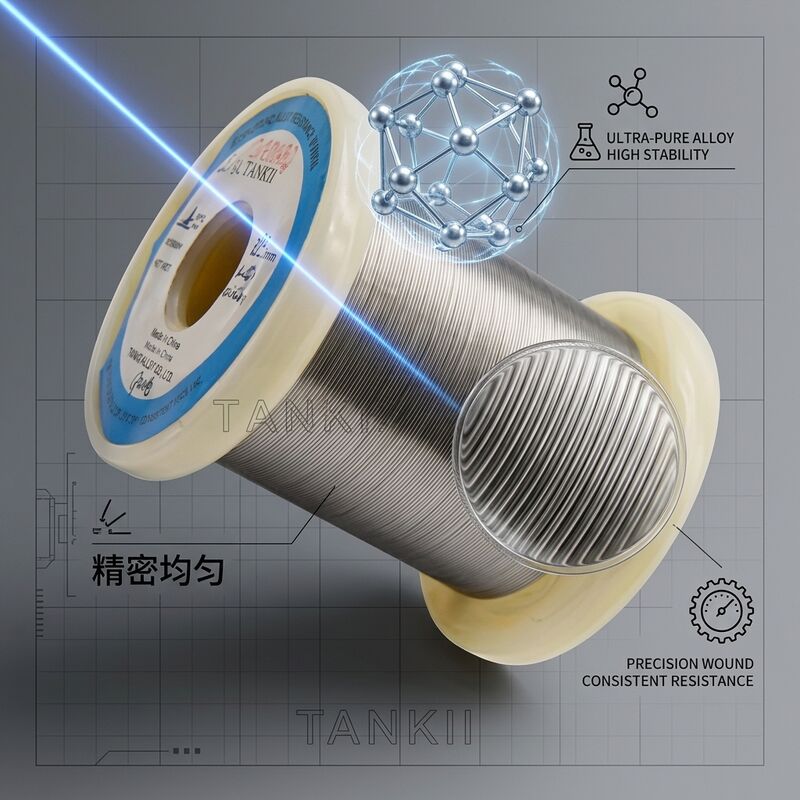
Product Details
Place of Origin: China
Brand Name: TANKII
Certification: ISO9001
Model Number: NiCr80/20 Ceramic Insulated
Payment & Shipping Terms
Minimum Order Quantity: 20 kg
Price: USD 18-45 / Kilogram
Packaging Details: VCI paper wrap, moisture barrier bag, foam cushion, export plywood case or heavy corrugated carton
Delivery Time: 3 working days for stock sizes, 15-25 days for production
Payment Terms: L/C,T/T,Western Union
Supply Ability: 20000 Kilograms per Month
Alloy Composition: |
Nickel 80% / Chromium 20% |
Conductor Diameter: |
0.2 Mm - 8.0 Mm |
Insulation Type: |
Ceramic Fibre Braid / Ceramic Bead String |
Maximum Continuous Temperature: |
1200 C In Air |
Electrical Resistivity: |
1.09 Ohm Mm2/m At 20 C |
Density: |
8.4 G/cm3 |
Melting Point: |
1400 C |
Elongation: |
Min 20% |
Magnetic Property: |
Non-magnetic, Austenitic |
Insulation Voltage Rating: |
300/500 V |
Delivery Form: |
Spool, Coil, Straight Length Or Pre-formed Element |
Nicr Alloy 80/20 nickel chrome resistance heating wire with ceramic insulation is engineered for continuous duty where bare resistance wire would oxidise, short circuit or lose its shape. The conductor is a drawn 80% nickel and 20% chromium alloy with a fully austenitic, non-magnetic structure, offering a resistivity of 1.09 Ohm mm2/m and reliable performance in air up to 1200 degrees Celsius. Around the wire we apply a dense ceramic fibre or ceramic bead insulation that withstands the same thermal envelope, keeping leakage current low even after thousands of thermal cycles. The finished cable is flexible enough to be bent around furnace fixtures, wound into spiral elements or threaded through narrow channels during installation, yet it keeps the conductor mechanically supported so element pitch does not drift over its service life. Every spool is dimensionally checked, resistance tested and supplied with a mill test certificate, so purchasing teams can qualify the material against their own element drawings without additional sampling rounds.
Key Features| Parameter | Specification |
|---|---|
| Alloy composition | Nickel 80 percent, Chromium 20 percent (NiCr 80/20) |
| Electrical resistivity at 20 degrees C | 1.09 +/- 0.05 Ohm mm2/m (diameter below 0.5 mm) |
| Resistivity, larger diameters | 1.13 +/- 0.05 Ohm mm2/m (0.50 to 3.00 mm); 1.14 +/- 0.05 Ohm mm2/m (above 3.0 mm) |
| Maximum continuous service temperature | 1200 degrees C in air |
| Melting point | 1400 degrees C |
| Density | 8.4 g/cm3 |
| Thermal conductivity | 60.3 kJ/m.h.degrees C |
| Coefficient of thermal expansion | 18.0 x 10⁻⁶ per degree C |
| Elongation at break | Minimum 20 percent |
| Micrographic structure and magnetism | Austenitic, non-magnetic |
| Standard conductor diameter range | 0.2 mm to 8.0 mm, other sizes on request |
| Insulation options | Ceramic fibre braid, ceramic bead string, ceramic fibre sleeve with stainless overbraid |
| Insulation voltage rating | 300 V to 500 V working voltage depending on sheath build |
| Delivery form | Spool, random coil, straight length or pre-formed element |
Ceramic insulated NiCr 80/20 heating cable is used wherever a resistance element has to run hot, stay electrically isolated and keep its geometry. Typical installations include industrial resistance furnaces, muffle and tube furnaces, laboratory kilns and ceramic firing chambers, plus radiant heaters for thermoforming machines and drying tunnels. Appliance manufacturers specify it inside electric ovens, grills, hot plates, water and oil immersion heaters, and warming cabinets where the ceramic sheath protects the element from moisture and metal contact. In process industries it serves as tracing cable for pipes and tanks that must stay above a set temperature, and as heating cord inside analytical instruments, soldering equipment and packaging seal bars. Because the alloy is non-magnetic and low drift, it also suits precision resistor coils and laboratory calibration loads. Our engineers can review your wattage, voltage and chamber temperature together and recommend the conductor diameter and sheath build that keeps surface load inside a safe range, so elements reach the intended life instead of failing early through overloading.
Packaging & Quality AssuranceEach spool is wrapped in VCI paper, sealed in a moisture barrier bag, cushioned with foam and packed in an export grade plywood case or heavy corrugated carton, with the coil weight, diameter, resistance and heat number printed on the label and the packing list. Ceramic insulated lengths are coiled at a radius that respects the minimum bend of the sheath and are protected with cardboard sleeves so the ceramic does not chip in transit. Every batch is checked for chemical composition by spectrometer, wire diameter by micrometre, resistance by four terminal measurement and surface condition by visual inspection; a mill test certificate covering chemistry and mechanical properties is issued with each shipment, and third party inspection such as SGS or BV can be arranged on request. Standard orders ship within 15 to 25 days, stock sizes within three working days, and we support continuous supply programmes with agreed safety stock for repeat element production.